Friday, May 11, 2018

Hamlet: My Vision

Imagine that you will direct Hamlet. Explain your vision and how it will be staged. Include specific details about the type of stage, tech elements, and overall concept for the show. 500 words. Due by midnight.


One of the difficulties in performing a work of Shakespeare’s is that, due to its age and language, modern audiences can have difficulty relating to it. With Hamlet in particular the barrier to entry is even higher since most of the plot revolves around the politics of a monarchy with an inactive, moody protagonist. If I were to direct a production of Hamlet, I would want to put a spin on it that eliminated as many of the walls between the source material and the audience as possible. One way I came up with to do that was to reimagine the story as being set in a modern college. Ophelia’s father Polonius would be a professor but all of the other major characters would be students. Claudius and Gertrude would be Hamlet’s close friends instead of elder family members, and instead of Hamlet’s father getting killed by Claudius, it would be Hamlet’s twin brother who committed suicide after being relentlessly bullied by Claudius. Gertrude was dating Hamlet’s twin but after his death started dating Claudius. The relationship between Claudius and Polonius would be that of a student sucking up to their teacher, who thinks the kid can do no wrong. Laertes would still be Ophelia’s brother, she and Hamlet would have had some form of past relationship, and she would still commit suicide during the events of the play. Horatio would still be Hamlet’s close friend and Rosencrantz and Guildenstern would be Hamlet’s former friends who go to a nearby school. 
The kind of stage I would want to have for this is a thrust stage, as it allows the audience to see the action from three out of four sides. It also opens your options for blocking and choreography. Normally you want your actors to be facing the audience as much as possible so that they can read the actors’ faces, but if you have the audience on three sides, then the actors can face those sides without having their backs to everyone. The main locations would be Hamlet’s dorm room, the auditorium where the play is performed, Polonius’ classroom, and the outside campus. Lighting, sound, and effects could work together to create a dreary, rainy atmosphere.

With the technicals, I want to make this story feel real and grounded. If the audience can relate to this version of the play, then perhaps they will get something out of it that they wouldn’t just reading or watching the original. Because of that, the costumes should be accurate to what young adults in modern times (jeans/sweatpants/shorts/skirts, shirts/t-shirts). In particular, Hamlet should be wearing dark, less formal clothes, since in his negative mental state he probably wouldn’t care about keeping up appearances. In contrast, Claudius and Gertrude might dress up more to show off their status. Ophelia should wear floral patterns with a focus on the color blue, since her character is symbolically tied to flowers and water.

Tuesday, May 8, 2018

Hamlet (Kenneth Branagh & Ethan Hawke): Directors' Visions

Kenneth Branagh version
I think the director’s vision for this version of Hamlet was to recreate the entire story in a style reminiscent of a fairy tale. Some of the aspects that I see as adding to this vision are the generally bright color pallet, particularly inside the castle, the clearly magical nature of the ghost, and the general sense of grandiose. This is particularly noticable in comparison to something like the Mel Brooks version, which is set in medieval times and has an overall dark, despressing tone. In Kenneth Branagh’s version, all of the dark symbolism is centered around the protagonsit, Hamlet, creating a stark construct between him and the many people who, he feels isolated from after this great tragedy he’s undergone.
Almost all of the story in this version is just directly recreating the original play; however, the few changes that were made seem to point towards the idea that this is meant to be a fairy tale. A prime example of this is when Polonius is reading the letter Hamlet wrote to Ophelia and we, the audience, see a brief flashback to Hamlet and Ophelia happily in bed together. This directly implies to the audience that Hamlet and Ophelia did once have a romantic relationship, like something out of a fairy tale. The original play does not have any flashbacks of this manner, and so the previous state of the relationship between Hamlet and Ophelia is left more vague, contributing to the greater complexity of the story as a whole. Of course fairy tales can be complex, and this production is far from simple. However, by deciding to answer one of the questions the source material provides, the Kenneth Branagh version of Hamlet is trying to say something about the nature of their relationship rather than leaving it up to the audience’s interpretation, and fairy tales are known for teaching lessons.


Ethan Hawke version
The Ethan Hawke version of Hamlet from 2000 is a wildly different adaptation that brings the story of Hamlet into what was then modern times. The vision of the director was not just to place this story in what would be a more familiar setting for its audience, but also to use what the modern setting provided him to advance the story. This version makes extensive use of the mediums of photography and film to tell the story in a new way and give the film as a whole a whole unique flavor. Ophelia, for example, is a photographer in this adaptation who takes and gives out pictures of flowers rather than actual flowers. The ghost of Hamlet’s father, though he later shows up as an actual spector, makes his first appearance on a tv. Instead of putting on a play to try and determine whether or not Claudius is guilty of murder, Hamlet instead puts together a short film with the same premise, using clips from old movies.
This last point in particular actually serves as a methaphor for the adaptiation itself as well - it takes the story of William Shakespeare’s Hamlet and remixes it, updating and rearranging the story. There are scenes that are cut or moved around, making it not a full adaption like the Kenneth Branagh movie. For example, early in the film we see a looped clip of Hamlet on multiple screens pointing a gun at his head, with the voiceover saying the famous line, “To be or not to be”. However, the full scene this line is from does not occur until later into the film, when Hamlet is in a dvd store. Ophelia’s suicide is also foreshadowed when, during a conversation between Claudius, Gertrude, and Polonius at an indoor pool, Ophelia hallucinates throwing herself in.

Friday, May 4, 2018

Tech Theater Review

Technical theater, referred to as “tech theater” for short, encompasses practically every aspect of a play’s production that does not directly involve the actors. This includes things such as set design and props, costumes and makeup, lighting, sound, and stage management. There are two sides to each of these aspects - the theoretical and the practical. The theoretical side deals with how each choice plays into the director’s vision or otherwise adds another symbolic layer to the production. On the other hand, the practical side deals with the physical, real world applications of these aspects.
One of the many roles technical theater contributes to is establishing the setting. The set design provides the audience with a representation of the world the play takes place in, with a varying level of abstraction, while costumes and makeup have to fit both the characters and the time period they live in. Lightning adds variation to the set and plays a large part in establishing the mood of the current scene, as well as which characters and elements are most significant. Sound, like lighting, serves to accent the setting, immersing the audience, and setting an atmosphere. When these aspects all work in harmony, they draw the viewers into the play - or, if the production is in a style more similar to someone like Brecht’s plays, serve to further highlight the falseness of the story. It all depends on what kind of tone you’re going for.

Every production is going to have different limits on it, such as the space, the budget, time, number of people participating, etc. These constraints will play directly into the practicalities of the show’s technical aspects. Obviously you can create a much grander and more detailed set for a play on Broadway than at a public high school (though there are certainly occasions where a more simplistic approach is preferable). Some shows will be able to create custom costumes for every role, tailoring them directly to the director’s vision, while smaller scale productions will have to rent their costumes and/or have the actors bring in whatever of their own possessions might prove useful to them or another character. The types of lights, and the number of each, are partially determined by the budget and the space. For an example, our black box theater does not have moving spotlights, which means that for a scene with a character pacing back and forth on stage, the lights have to be positioned in a specific way and changed at just the right time to keep the actor illuminated for the audience. When it comes to sound, any pre-recorded sound effects that the show requires will need to be found or created, saved, and then played at the right moment, at the right volume. If the sound effect is off time, too quiet to hear, or so loud that it overpowers critical dialogue, the whole scene can be ruined. All the actors’ audio levels have to be balanced, which becomes especially tricking if some of them share microphones and have to switch them out mid-show.

Monday, April 30, 2018

Casting Heathers

If I were to cast Heathers the musical for a production here at Cheshire Academy, I would cast...

  • Ray Dong as Jason Dean. He’s one of the stronger males we currently have doing musical theater in my opinion, and compared to the others, I think he’d be best at carrying through a genuine, not too cheesy “bad boy” persona. He’s confident, brash, and passionate when singing, qualities that would heighten J.D.’s conviction to his goals.
  • Nan Zhou or Olivia Willaimson as Martha. Martha is sweet, loyal and supportive, but doesn’t have the confidence to stand up for herself. Both of the actresses I picked have strong singing voices - and personalities - but sometimes have to be coaxed to bring them out. Nan and Olivia also fits the body type that Martha calls for (since she gets specifically made fun of for her weight).
  • Julia Rafferty as Heather Duke. She has the strong singing voice the role calls for, and a powerful stage presence that can come out more after Heather Chandler dies. This one’s more of a hunch feeling.
  • Me or Maggie as Veronica Sawyer. We both can hit high notes and are sort of nerdy. 

Difficulties of Tech Theater

One of the major obstacles I imagine theaters face when it comes to the technicals is the available space and budget. This is obvious when comparing, say, our school's performance of Les Miserables last season, versus when we went to see it at the Bushnell Theater. We didn’t have moving spotlights, a green screen to play special effects of off when Javert jumped off of the bridge, a barricade that could be fully rotated to show off the bodies of the dead students, etc. Because of all this, our adaptation was not able to have quite the epic scale that the Bushnell did, and that’s something that had to be worked around going in.
Another difficulty which can arise from technical theater is trying to consolidate the visions of all of the different people working on the show. The director is ultimately the one with the full vision that the show will embody, but they also have to give the people in charge of the costumes, lights, sound, and set to use their own talents to bring those visions to life. Sometimes the director’s vision is impractical, self-contradictory in places, or doesn’t jive well with the material. If not developed in harmony, you can have aspects that fail to form a cohesive whole - for example, without prior arrangements being made, the color pallets of the lights, set, and costumes might end up clashing. Cooperation and communication is key. 
After doing this unit on technical theater, the aspect of it which I think is the most difficult to nail is set design. You have to physically transform the space into the world of the show, providing enough detail to make it feel immersive but not so much as to get in the way of or overshadow the actors. Building on this, most shows have multiple locations, which means that the set has to be easily changeable so as to waste the audience’s time with scene changes as little as possible. Aspects that can’t be moved on and off stage mid-performance have to be crafted to not seem out of place in any of the scenes. Productions with a lower budget will also have less supplies to use for crafting unique elements and will have to rely on pre-existing materials a lot of the time.
To go back to our past production of Les Miserables as an example, the play required us to have a bridge as a set piece for Javert’s suicide; however, we would not be able to bring it on and off stage, so it had to be against the back wall for the whole show. To make up for this, we had a set of five giant wooden triangular prisms painted with a different background on each side, which could he wheeled on and off stage during scene changes to block the bridge from view and create the illusion of being indoors (or in a garden). The main problem with this approach was that, with both the bridge and triangles on stage at the same time, there was much less space for the actors to work in, so we used the triangles as little as possible, with a painted backdrop of a generic setting-appropriate city at night on the wall behind the bridge fitting the mood and serving the “outdoor” scenes well enough. The river over which the bridge supposedly ran was also included in the backdrop to give the bridge some context and make it fit in the scenes. The other major element of our set was the barricade, crafted from found elements and built on three separate platforms to make it easier to hide backstage during the first act.

Sunday, April 29, 2018

Seventeen (Heathers) Project Essay

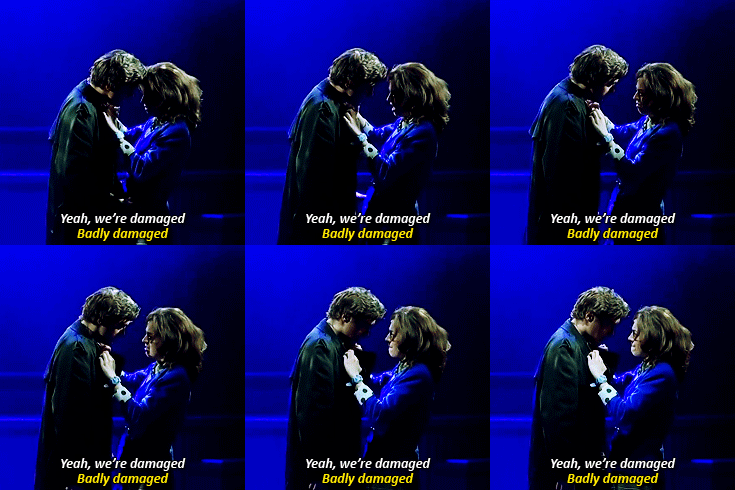
If I were to be the tech director for a single scene from a play, I would want to do the sing “Seventeen” from the musical “Heathers”. I choose this scene because, despite its simplicity, it can be incredibly moving if done correctly. For context, this song is right after the start of Act Two, after our high school leads, Veronica Sawyer and her boyfriend J.D., have just witnessed the funeral of the two jocks they had killed and staged as a double suicide the night before. Veronica hadn’t realized J.D.’s true intentions at the time, and when he seems willing to kill even more people, her angry outburst prompts the song. In it, she begs him to give up on his twisted vigilantism and at least try to have a normal teenage relationship with her. The song transitions from fed up and fiery, to gentle and down to earth, to soaring and hopeful, to cautious and fragile. Applying the different aspects of tech theater can help to heighten these emotional peaks and make the scene unforgettable.

My vision for this scene is to create a moment that stands out from the rest of the show as being fantastical in nature versus grounded in reality. Part of the tragedy of “Heathers” is how the realistic toxic relationship Veronica and J.D. find themselves in lead to serious, permanent consequences, and that just hoping things will get better isn’t enough; you have to dedicate yourself to improving the situation and avoid falling into old habits, which J.D. unfortunately fails at. This scene represents the height of Veronica’s love-struck fantasies, trying to hold together a relationship that isn’t worth it because of the pure, almost holy potential she envisions for them. If the scene is put together in a way that draws the audience into that fantasy, it will make them empathize with Veronica, and thus make the end of the show much more tragic, while also highlighting the impossibility of the desired happy ending.

In its original off-Broadway run, the set for “Heathers” was very simple and hardly decorated, just two levels with short stairs on either side of the raised stage. While this abstract set works fine for the show, with the time and budget to expand upon it, I think you could use the location to add to the subtext of the scene. Having two levels to the stage creates an opportunity to use it as symbolism for the real world and the evaluated fantasy world. The scene could be choreographed to have Veronica bring J.D. to the higher level as she wins him over with her idea of their idealized romance. 
Since this scene takes place directly after the funeral, you could have some decorations to show that Veronica and J.D. are still in the church for the song, such as candles (probably not actually lit), a cross standing or on a wall, a pulpit. etc. 

With just these few additions keeping the setting in the audiences’ minds as the scene unfolds, it frames the romance as something holy, which tied into one of the show’s musical motifs - “Our love is God”. However, doing this would also make the scene more grounded during the parts where it is meant to transport the audience out of the real world. To remedy this, you could have the more noticeable props somehow be moved off of the stage before the climax of the song so that it doesn’t take away from the fantasy.

The sound and lighting would be the other major factors that would help create the ethereal effect of the scene. The band/orchestra would have to carry those emotions described in the previous paragraph; listening to the soundtrack, you can see they use lots of strings instruments in this song to achieve that effect. The lighting can make us of the prevalent color motifs in the show as well. In practically every version of the Heathers story, Veronica is associated with blue, while J.D. is associated with black. The other color to focus on in this scene would be red, which is commonly associated with both love and violent rage. Going through the scene step by step, Veronica starts the song in a burst of anger, and feels like she and J.D. aren’t on the same page, so the musical jabs should be loud and harsh, and there should be a red spotlight on Veronica. As she calms down and pleads to J.D., the music should get softer, a second spotlight should appear over J.D., and the colors should shift from red to blue, symbolizing Veronica winning him over. When the song hits the second chorus, the two of them should be on the higher level of the stage, and the floodlights should be on, filling the stage with white and gold, colors tied to heaven and purity. The music should be loud and soaring, really using those strings. Then there’s a moment where Veronica and J.D. get caught up in their emotions and kiss, but then awkwardly end it because there’s a sense that they shouldn’t be getting back into that kind of thing yet. Here the floodlights should go off, and the only light should be a single spotlight that covers both Veronica and J.D. as they face each other. The color can be pink, which has the love connotations that red does but not those of anger and violence, and the sound should quiet down.

To close out, I’ll briefly discuss the characters’ costumes and makeup. Since J.D. is resistant to change and doesn’t care about societal norms, he always wears a black coat, with a dark shirt underneath, and black shoes. He probably wouldn’t dress up for the funeral, the most maybe being a tie. On the other hand hand, Veronica, who has more respect for people, would dress up more. She could wear a black coat (fancier than J.D.'s) and then take it off for the song, with her regular blue  outfit underneath to fit with the color symbolism of the lights.